Friday, 13 November 2009

And on a lighter note.....

http://www.wired.com/images/article/full/2008/02/clitoraid_350px.jpg

Dressing up as a clitoris to help www.clitoriaid.org - an organisation that offers surgery to help rebuild the clitoris. Apparently this operation is more successful if the girl is cut later in life and if the severing of the clitoris is not too deep....

Incidentally, there is a discussion at the moment, following on from the BBCs coverage of warnings about labioplasty here in the UK. The general gist on twitter (which I'm losing faith with) is that labioplasty is the western form of FGM.

There is a simple reason why they're not comparable: choice. If women choose any type of surgery, that is their prerogative - they may be subliminally manipulated by the cultural hegemony in place, but at the end of the day, they undergo surgery and the risks to improve their own body image. As far as I can see it, labioplasty does not contravene a single Universal Human Right.

FGM on the other hand.... I'm not sure I even need to go any further. We can start with the age of the girl (anywhere from 9 days to beyond puberty), the absolute lack of choice, the horrific health impacts, the psychological impacts, the fact that it is not an anesthetized (sp?) operation.

In terms of human rights, FGM certainly contravenes the right to life and the right not to be tortured or treated in an inhuman or degrading way. It spans health rights, child rights and human rights.

So in short, a comparator of the two is not helpful - in my opinion, it actually undermines the severity of the issues that FGM raises.

Friday, 6 November 2009

FGM as a weapon of conflict

It's exactly a year since I returned from Lalibela to Addis. Which again, makes me think of my talisman photograph of the two smiling girls, who hijacked us, as we wound our way through the small paths and stumbled upon churches, the infamous rock hewn Lalibela churches.

Who would have thought my journey would have brought me here one year later?

I'm building up to something. Two things in fact. And clearly I think that by beating around the bush and meandering in memories, that it will save me from having to tell you. See, even now, my innate sense is to protect, rather than to reveal.


OK - you know I blogged about a photograph? Here it is:


I won't go over thoughts, feelings, perceptions - as I did that in an earlier post. All I can do is leave it out there - let it speak for itself.


The second issue - if it's possible, is almost harder. I sat at FORWARD's AGM last week and talked with one of the trustees, who is Kenyan. We discussed the politics of Kenya, the uncertainty of Kenya.

She leaned over to me and said, conspiratorially (we all at some points, whisper about FGM - although sometimes, we speak it loud and clear) "one of the things that's happening in Kenya..." (deep breath, glance around the room, back at me, finding my eyes) "women are being forced to go through FGM"

A few moments for it to be understood, then I see what she's saying. "It's bad enough that rape and violence is so prevalent - but if a woman is raped and they see she has a clitoris, they cut it out."

FGM as a weapon of conflict. Of course it is. How stupid of me not to have seen it before - or even, not to have somehow known it.

And so this journey unfolds, continues.

Not much left to say today.


Wednesday, 4 November 2009

Guest blog spot on Unltd's blog here......

http://unltdworld.com/blog/view.php?id=161

What income stream attaches itself to behavioural change?

Posted on November 4, 2009, 11:55 am

I've watched you social entrepreneurs from afar. A bit like hanging out at the school gates, not quite part of the group, seeing you play in the playground, wondering if I can be your friend.

The reality is, probably no. Or perhaps yes. Perhaps once you've read this blog post, you could feed me inspiration, thought-provoking ideas?

See, my passion is a difficult thing. My passion is to inspire behavioural change in one of the most complex, culturally sensitive, difficult areas.


Photo: Nick Cornwall

I travelled to Ethiopia last year, as a volunteer with VSO. I did all my reading and preparation. But really, nothing prepared me for female genital mutilation. I'm not sure anything can. In some ways, I feel I was lucky, in that my introduction to it was quite pure - there I was in Ethiopia, living a volunteer's life, interacting with Ethiopian people. How much better than casually coming across a book - perhaps it would not have mattered to me, if all I had done was read yet another news report about an atrocity happening in a far away land.

As it was, I met women, I met girls, much like these, in one of the most sacred places I'd ever been, Lalibela in the north of Ethiopia.

The knowledge that these girls are likely to have their clitorises and labia cut out is almost unbearable. Cut out because these parts offend. It is a tradition now so steeped in history that it predates both Christianity and Islam. It is a tradition that is so powerfully culturally embedded that mothers and grandmothers do it to their own daughters. The patriarchal appropriation is complete - women believe by doing this that they are freeing their girls from the ugliness of genitals that if left, would grow down to their knees. The smell would be horrific. The irony is of course, that so many girls who are cut go through lifelong issues of repeated infections and odours.

More and perhaps most importantly, by going through this ritual, their daughters are cleansed for marriage. An uncut woman will remain unmarried. And in Ethiopia, that means she will remain status-less. It is literally inconceivable to be unmarried.

So what is at the root of FGM? Clearly, female control. But it is wider than this. It's done to ensure first virginity, then chastity. This is because its most extreme form, infibulation, means that the wound is also sewn up. A hard plug of scar tissue forms - literally the body's own chastity belt. This is then cut open, on a girl's wedding night (because child marriage is still the norm) and also at every subsequent birth - cut open, sewed back up again.

There are other reasons. Even though it predates religion, many people believe that it is part of Islamic culture. Few imans preach against it. Most in fact believe it is the same status as male circumcision, which is promoted in the Qu'ran. Christiantiy too in Africa remains pretty silent about it.

So enough of the FGM lesson. Why am I standing at the school gates, nose pressed, looking in?

Because a social enterprise, as far as I can work out, needs an income stream. What income stream to help these girls? What income stream attaches itself to behavioural change? Perhaps training - but this issue needs community driven, embedded work. On a massive scale. It needs advocates within communities, not do-gooders from across the seas telling others how to live their lives.

All I can think of is a straightforward model of fundarising here to channel to those over there. The intervention? Community based education. Community health workers who can tell of the links between girls' problems and FGM. Wholescale community shifts towards allowing girls who are not cut to be married (very achievably - this is the UNICEF/Innocenti approach, predicated on game theory). Giving circumcisers economic alternatives to support their livelihoods. Asking National Governments to enforce their own laws that ban FGM (in 24 of the 28 practising countries) and asking international players to really step up to the plate and start using their influence.

So, that's an introduction to the vagaries of FGM.

I hold those little girls in my mind though, as I go through trying to make sense of all this. I've given up full time work to both volunteer on this but also to somehow make some practicable change. I find the NGO world difficult to penetrate, obscure and behemoth like. The private sector has little interest, for obvious reasons. Little girls in Africa? The funding world finds little to do, concentrating on infectious diseases like malaria.

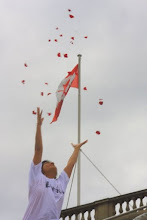
I found myself on the plinth on day 4. It was a remarkable humbling experience to stand in orange, pull on 40 different t-shirts all with different countries and then cut the petals of a red rose and fling them into the air, with the words: "This is for the three million girls around the world, who will be cut this year." The crowd stayed with me. Afterwards, people came up to me, put their arms around me. One man in a disabled buggy came over and simply said, "I didn't know. I just didn't know - thank you." That seemed to say it all.

Like what Julia has to say? Completely disagree? Sign Up (http://unltdworld.com/pages/signup.php)to UnLtdWorld to comment on this blog...


Friday, 23 October 2009

Quick response to Avaaz on FGM - posted on Facebook

For up to date information, research and news on FGM, please visit www.forwarduk.org.uk - and if you care about this issue, please consider getting involved in some form.

Personally, I would love Avaaz to campaign on this issue because there needs to be much more awareness about it, and it is only through education and advocacy that we will begin to get a real shift in this complex practice. If Avaaz's followers chose to make this an issue, then it could be taken much more seriously around the world.

That's the power of the network today - I'm a fan and supporter of Avaaz - and I think there's an interesting debate about whether they respond to their members issues or set their own agenda.... Read More

Ricken is right to an extent, in the original quote - FGM currently would come way down people's priority lists. It's just too taboo and difficult to touch.

However, if Avaaz chose to campaign on FGM, the awareness raised would be remarkable - and then this issue might get the level of funding needed (which, let's face it comes from the West) to make an impact at any serious level. Meanwhile, those 3 million girls a year keep on getting cut.

A multi-level approach is needed - at a community level to explain the health impacts, at a national level to ensure that countries see this as illegal and also adopt enforcement, at a Pan-African level (altho it happens in Indonesia, and other parts of the world too) and at an international/global level to ensure that agencies and others involved have a coherent, funded plan to really meet the UN stated aim of "eradicating FGM within this generation."

At the moment we are woefully far from this.

The other main issue is that this practice predates both Christianity and Islam - it is a question of female control. It ensures women's chastity and fidelity in one brutal stroke. Projects that work towards female empowerment do make a different in the debate. UNICEF research also shows that when whole villages adopt a shift away from FGM (meaning no one woman is penalised by not being allowed to marry if she is uncut) then change really can happen.

This practice is a human rights violation, a child rights violation and it denies girls their own opportunity to reach their potential.

We should all do anything we can to help shift this debate. Please!

Here is Avaaz's orignial response:

Thanks to all for comments on female genital mutilation - there seems to be a lot of misunderstanding about Avaaz's position.

Avaaz is a member-driven organization - we use polls of our membership to set our priorities and decide our course. There are so many vital issues in the world today, and FGM is certainly one of them, but it's just impossible to campaign on all of them. Unlike traditional NGOs where staff, board and funders decide priorities, our members make the difficult and sometimes painful decisions about which campaigns our community focuses on. It's really important to our democratic model of campaigning that it's our membership as a whole, and not any small group of members or staff, that decides what we work on.

Our community is passionate about human rights and women's rights. Almost half of our campaigns have been human rights-related campaigns, including for example the prevention of mass rape in the Congo and accountability for rape and genocide in Sudan. We've also focused heavily on human rights in countries like Zimbabwe, Tibet and Burma. But so far, Avaaz members have not chosen FGM as one of our most important priorities.

We wish the WHOA FGM campaign all the best in educating people about this serious issue, and hope we can join the cause when Avaaz members choose to. We're grateful to everyone who has posted civil and respectful comments, but we're very concerned that one of your members is sending abusive and threatening messages to Avaaz staff on personal accounts - please let's have a mature and respectful discussion and not threaten and demonize people whose job it is to serve the Avaaz community by working hard on many good causes.

The Avaaz Team

Thursday, 22 October 2009

The Matrix and FGM....

I've recently read an FGM publication written by Nahid Toubia "A Global Call to Action."

The thing that stopped me in my steps though was a photograph of an infibulated seven year old Sudanese girl. I wish I could reproduce it here. I guess words will have to do.

All you see is her brown legs apart, lower down, the black star of her anus. Above this, a wider hole - almost like a belly button - some sort of orifice, puckered. Above that - nothing. Absolutely nothing - smooth smooth skin. Clearly she is too young to have pubic hair, but the pristine smoothness of this skin apalls and amazes me.

I mused with my friend Ben about it. He instantly hit on something: "it sounds like the body of an android" - that seemed to say it. De-sexed. Everything internal is intact (unless it is ravished by infection and succumbs to all of the health stresses that happen as a result of FGM) women are able to still have sex, still give birth, but everything in this area is now controlled by others.

My other analogy is a Barbie doll. And the smoothness of the plastic reminds me of the skin with no marks. Perhaps you may connect with a more modern analogy, which Julian told me of - Neo in the Matrix. The point where his mouth disappears and all that is left is the bold line of his face, mouthless. This is the same, but vulva-less.

The photograph haunts me. Worse, I go around showing it to everyone. I am lucky in my friends - they don't shy away - even Brett, the hairdresser in Smithfield, wants to know more, doesn't baulk from talking.

I realise I now might have to find a way of reproducing the photo.... will do my best.

I wanted to quote directly from her report:

"The thinking of an African woman who believes "FGM is the fashionable thing to do to become a real woman" is not so different from that of an American woman who has breast implants to appear more feminine. Presented below are some of the reasons given for FGM:

BEAUTY/CLEANLINESS
Female genitals are unhygienic and need to be cleaned
Female genitals are ugly and will grow to become unwieldy if they are not cut back
FGM is a fashionable thing to do to become a real woman

MALE PROTECTION/APPROVAL
FGM is an intiation into womanhood and into the tribe
The noncircumcised cannot be married
FGM enhances the husband's sexual pleasure
FGM makes vaginal intercourse more desirable than clitoral stimulation

HEALTH
FGM improves fertility and prevents maternal and infant mortality

RELIGION
God sanctifies FGM

MORALITY
FGM safeguards virginity
FGM cures "sexual deviance" ie frigidity, lesbianism, sexual arousal.

None of the underlying messages and language used to justify FGM is unique to Africa. These messages reflect a universal language used to perpetuate women's second-class status and a re reminiscent of reasons given for slavery, colonialism and racism."

The whole report is well-written and I glean facts from it that I haven't done elsewhere - in particular, issues around the cutting and recutting around childbirth and "access" for marriage. It also talks about the recognition that whilst infibulation is seen as the pratice that has most impact health wise, this can leave clitoridectomies seeming almost acceptable. In fact, some communities "downgrade" to removing the clitoris.

This is a discussion I had with friends recently - one said that she felt that if the practice could be done more hygienically, by medical professionals, that this would make it much safer.

To me, this is anathema and indeed, Toubia points out that this is one of the gravest issues - if the practice is put into the hands of the medical profession and seen as helpful, then all of us advocates will be set back by at least 30 years. It will have been appropriated by the system, and there it will stay - wresting back control of women's bodies will be even harder than now.

Wednesday, 16 September 2009

UN Women's Agency approved!

Remarkable scenes!

In spite of doom laden scenarios, the UN General Assembly voted unanimously yesterday to go ahead with the UN Women's Agency.....

Now the real work begins.....

Sunday, 13 September 2009

The UN should not be beyond women's grasp....

And yet, to so many of us, it is.

The UN is often seen as a huge lumbering beast, that only looks to its own self-fulfilling concerns. Yet most recently, talk of reform has been on the table. Reform of the UN's funding and its structure.

Part of this reform has been a discussion about setting up a dedicated UN Women's Agency, which could affect the lives of women the world over. Much has been done. Many countries have agreed the need for it. A resolution has been put forward to the UN General Assembly. However, it is mired in the horse-trading and geo-political discussions that accompany the signing of any resolution. It is in danger of not being signed at all (see Mark Tran's article here: http://www.guardian.co.uk/world/2009/sep/11/ratification-un-women-agency-threatened).

The resolution must be passed by today, 14th September, 2009. Who knows what will happen. If it is passed, we are on our way to creating an autonomous, fully funded, dedicated agency for women, that has vowed to work in partnership with CSOs on the ground and have the proper level of leadership needed for this important body.

It is most desperately needed.

A quick glance at UN statistics (courtesy of GEAR) show that the women's agencies spend is a terribly low $221m - and this against a global UN spend in 2008 of $27bn. This means that fewer than 1% is spent on gender equality within the UN.

Rather than give a whole level of detail about the background, you can access the campaign here: http://www.un-gear.eu/home.shtml. The home page has some sobering statistics:
  • Every minute of every day, a woman dies in childbirth - a statistic that hasn't improved in two decades
  • 70% of the world's poor and 67% of the world's illiterate are women
  • In 141 countries, marital rape remains a legal activity
  • Only 9% of HIV+ women in the developing world have access to treatment that blocks passing their HIV onto newborn
And yet still, we have no dedicated body in the UN that is responsible for women, or responsible for delivering the Millennium Development Goals that affect half of our population.

As someone on the ground, simply campaigning for a better life for women, I'm still wholeheartedly shocked at how our global hegemonies spout the rhetoric, yet do so little in practice. This is a prime example.

For those who argue that we will simply be creating a whole new UN instrument in the form of its predecessors, I would argue that in order to beat the system, sometimes you need to infiltrate from within and play with the same orchestra....

Let's all hope today's vote goes the way we need it to.